Evaluating Viral Social Media Trends | Verified US Shipping & Price Updates
*Live promotional pricing updated for US buyers
🛒 Check Today's Best Price on AliExpressViral Products / Evidence-First Buying Guide
A $5.45 cable can tidy an LED installation—or introduce its weakest electrical connection. The difference depends on specifications a polished lighting video rarely reveals.
Evidence disclosure: This assessment uses the supplied product name and price, established electrical principles, and linked consumer guidance. No listing URL, manufacturer datasheet, independent certification, purchased sample, or social-engagement data was supplied. Accordingly, the product’s claimed 2A capacity is unverified, no measurements are presented as hands-on results, and neither viral popularity nor current shipping benefits are assumed.
1. Executive Briefing & Market Dynamics
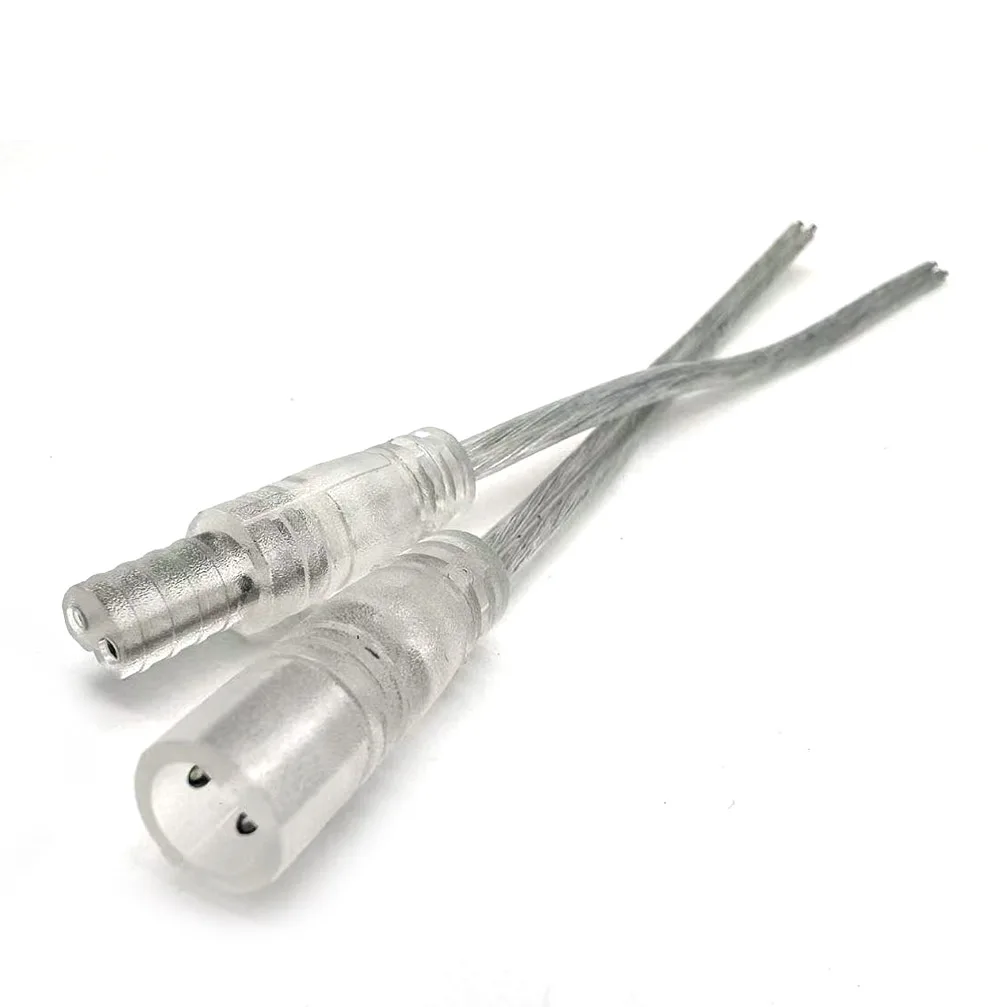
The product described as a “2A Power Adapter Transparent Pigtail Cable Female Male Barrel Jack Connector Extension Cord For LED Strip Light” appears intended to extend a low-voltage DC power connection. Its practical appeal is straightforward: move a power supply farther from a strip, conceal wiring behind furniture, or bridge an inconvenient gap without soldering. Despite “power adapter” in the title, an ordinary passive extension neither converts wall voltage nor increases available power.
Ambient-lighting videos make this accessory category especially tempting. A finished desk or backlit television looks effortless; the less photogenic details—connector dimensions, polarity, conductor size, and power distribution—usually disappear from the edit. That is the central problem when evaluating social-media lighting trends: visual success demonstrates an aesthetic outcome, not electrical compatibility or sustained-load safety.
The broader market favors modular lighting assembled from separately sourced strips, controllers, supplies, and accessories. Standard-looking barrel connectors make that ecosystem approachable, but appearance does not establish interchangeability. Two plugs can look identical on camera while differing in their internal bore or insertion length. Nor does a creator’s short installation prove that a similar-looking cable will support your longer, brighter strip.
At the supplied $5.45 price, the relevant comparison is the landed cost of a verified equivalent, not merely the price of another transparent lead. US-stocked accessories may include faster delivery, clearer specifications, domestic returns, or more accountable distribution. Marketplace sellers can reduce some retail and inventory costs, but a marketplace listing is not proof of direct factory sourcing. Without matching length, gauge, connector dimensions, quantity, and shipping charges, a precise savings claim would be misleading.
Our preliminary verdict: potentially reasonable for an accessible, low-demand installation once compatibility is documented. It is not an automatic recommendation for long runs, concealed installations, or operation near the advertised current limit. The cable is inexpensive; diagnosing flicker behind a mounted television is not. Missing specifications should therefore count against value rather than be treated as harmless omissions.
2. Technical Architecture, Component Engineering & Material Metallurgy
A conventional male-to-female DC extension contains two conductors, connector contacts, insulating material, and terminations. It normally has no PCB, chipset, voltage regulator, or communications circuitry. Those components cannot meaningfully be evaluated here unless the actual product contains additional electronics. “Pigtail” sometimes means a connector with free wire ends, so photographs must establish whether this is one complete extension, separate leads, or an assembly requiring user termination.
Conductor metallurgy matters more than transparency. Stranded copper generally offers lower resistance than an equivalent cross-section of aluminum-based conductor and tolerates repeated movement better than a solid wire intended for stationary use. Copper-clad aluminum can reduce material cost but requires more cross-sectional area to achieve comparable resistance. Neither a clear jacket nor copper-colored strands prove solid-copper construction. Gauge, conductor material, and measured resistance are the useful evidence.
Connector contacts are often manufactured from copper alloys, including brass, with surface finishes chosen for corrosion resistance and wear. This product’s alloy and plating are unknown. Contact geometry and spring pressure can matter as much as the finish: a loose fit reduces effective contact area, increases resistance, and concentrates heating. A frequently encountered distinction is 5.5 × 2.1 mm versus 5.5 × 2.5 mm barrel sizing. A plug with an oversized internal bore may appear to fit a smaller pin while connecting unreliably.
A transparent jacket might be PVC or another polymer; its composition cannot be identified reliably from a title. Useful attributes include temperature rating, insulation thickness, flexibility, and resistance to abrasion and aging. Clear insulation may make broken strands or discoloration easier to notice, but it does not establish flame performance, suitability inside walls, or resistance to sunlight. Installed against pale furniture, it may also remain more visible than social-media photography suggests.
Thermal performance follows ordinary circuit physics. Voltage drop is current multiplied by resistance, and heating is current squared multiplied by resistance. Doubling current therefore quadruples resistive heating in the same cable. Both conductors contribute to the circuit’s resistance, as do contacts and terminations. There is no active thermal management; heat escapes through the assembly into its surroundings.
Mechanical engineering completes the picture. Molded strain relief should transfer pulling and bending forces away from soldered or crimped joints. A connector hanging under its own cable weight, squeezed behind cabinetry, or sharply bent at its exit experiences more stress than one supported on an open shelf. Barrel plugs are convenient, but ordinary friction-fit designs provide neither a locking connection nor a general guarantee of moisture protection.
3. Empirical Benchmarks & Real-World Stress Testing
No defensible empirical score can be assigned without a sample. The following is a reproducible evaluation protocol, not a report of completed testing. A proper bench setup uses a current-limited DC supply, an electronic load, voltage and current measurement, and contact-temperature sensors. Testing should never require opening a mains adapter. Consumers without suitable equipment should prioritize documented specifications rather than improvising a full-load experiment.
First, record the exact assembly length, connector dimensions, conductor markings, and visible workmanship. With the cable disconnected from power, check continuity, center-to-center and sleeve-to-sleeve wiring, and the absence of a short between conductors. Confirm the assembled system’s polarity before connecting the LED controller. If construction or ratings remain unclear, that is grounds to stop—not an invitation to find its failure point.
For a sample supported by an adequate voltage rating, an evaluator could characterize operation at 12V DC and staged loads of 0.5A, 1A, 1.5A, and 2A, provided inspection and earlier stages show no problem. Measure voltage immediately before and after the extension so upstream supply sag is not mistaken for cable loss. An example—not a result for this product—is a 0.30V drop at 2A: that corresponds to 0.15 ohm total resistance and 0.60W dissipated across the extension.
Temperature testing should include the connector shells, strain-relief areas, and cable midpoint. Start near a recorded room temperature of 23°C, then monitor a supervised representative eight-hour operating period at the intended load. A separate warmer-environment evaluation can assess reduced cooling, but only within documented component limits. Transparent and reflective surfaces complicate infrared readings; attached sensors are preferable when accurate surface temperature matters. Stop for instability, deformation, odor, or rapid localized heating.
The real lighting test should use maximum intended brightness and the highest-consumption supported mode—often full white—rather than a dim demonstration scene. Check voltage at the strip input and observe flicker, controller resets, and brightness changes. Comparing operation with and without the extension helps isolate its contribution. A downstream strip can still dim along its length even when the extension performs adequately.
Durability screening could include 100 unpowered mating cycles followed by repeat resistance measurements and a documented, repeatable flex test. That is a comparative screen, not a lifetime prediction or standards certification. Latency and decibel output are not useful primary metrics for a passive lead: it performs no data processing and should produce no operating sound. Battery drain matters only in a battery-powered system, where cable loss adds demand or reduces delivered power. The decision-relevant benchmarks remain voltage drop, temperature rise, contact stability, and mechanical durability.
4. Quantitative Specification & Performance Parameter Sheet
The specification sheet should separate seller wording from established capability. These are the parameters that determine compatibility and usefulness; most cannot be recovered from the supplied title.
| Parameter | Available Evidence and Implication |
|---|---|
| Price | $5.45 as supplied; quantity, shipping, tax, and import charges unspecified. |
| Current | 2A in title; continuous rating, ambient conditions, and validation unknown. |
| Voltage | Not supplied. Intended DC voltage must fall within documented ratings. |
| Connector geometry | Male/female barrel terminology only; outside diameter, bore, and engagement length unknown. |
| Polarity | Unspecified; confirm straight-through wiring and equipment requirements. |
| Conductors | Length, AWG, material, strand count, and resistance unspecified. |
| Environmental limits | No verified temperature, outdoor, water-ingress, or in-wall rating. |
| Compliance | No independently checked certification or traceable test report supplied. |
Power follows voltage multiplied by current. At an actual 2A load, 5V corresponds to 10W, 12V to 24W, and 24V to 48W. These are arithmetic reference points, not verified wattage ratings. A 2A title does not establish that the insulation or connector supports every voltage in that list.
Resistance also changes the practical picture. Using the illustrative 0.15-ohm loop resistance, a 2A load loses 0.30V: 6% of 5V, 2.5% of 12V, or 1.25% of 24V. These percentages isolate the extension; they exclude losses in the supply lead and strip. Shorter, thicker conductors generally reduce loss, while poor contacts can undermine an otherwise adequate cable.
5. Rigorous Pros, Cons & Trade-Offs Matrix
The strongest argument for this category is convenience. If the assembly is genuinely male-to-female and correctly matched, it preserves a detachable installation without soldering. That can make cleaning, furniture changes, and component replacement easier. For a small lighting load, a short, well-made extension can introduce little practical penalty. The difficulty is establishing that this specific product meets those conditions.
| Potential Strength | Budget Trade-Off |
|---|---|
| Low purchase price | Replacement delays and return costs can outweigh small savings. |
| Tool-free connection | Similar-looking barrels may have incompatible dimensions. |
| Passive construction | No regulation, overload management, or assured fault protection. |
| Transparent appearance | Visibility does not establish conductor quality or insulation performance. |
| Flexible placement | Additional length and junctions increase resistance and failure opportunities. |
A passive design avoids firmware problems, wireless pairing, and app dependence. It also cannot correct an undersized power supply, reversed polarity, or an overloaded lighting system. Calling it simple should not imply that it is self-protecting. Fault behavior depends substantially on the upstream supply and the complete installation.
The biggest budget compromise is therefore not necessarily inferior materials; it is uncertainty. Missing gauge, length, and thermal limits prevent a meaningful comparison with a documented alternative. A higher-priced cable is not automatically better, but a traceable specification gives the buyer something measurable to evaluate and a seller something concrete to stand behind.
This product becomes less attractive when failure is disruptive: lighting beneath permanent cabinetry, around heat-sensitive finishes, or behind equipment that is difficult to move. Accessible accent lighting is a more forgiving application. Even there, operation near an unverified maximum leaves little basis for confidence. Choose a documented higher-capacity assembly when demand approaches 2A, and remember that the weakest connector still limits the complete path.
6. US Logistics, Customs Clearance & Consumer Rights
Treat $5.45 as a starting price until checkout establishes the final total. Shipping method, warehouse location, delivery estimate, taxes, and any disclosed import charges affect value. US import policy can change, so older advice that every inexpensive parcel enters duty-free should not guide a purchase. Check current US Customs and Border Protection guidance for internet purchases; actual treatment depends on origin, classification, and the applicable entry rules.
International tracking can pass through multiple logistics providers. A shipment may receive a domestic tracking number before the final-mile carrier physically accepts it. If USPS handles delivery, “Shipping Label Created” is not equivalent to possession. Check the official USPS website and retain both international and domestic identifiers when available. A stalled scan does not by itself prove loss or a customs seizure.
Do not assume this listing qualifies for AliExpress Choice simply because it appears on AliExpress. Choice, delivery commitments, free returns, and buyer-protection remedies are program- and order-specific. Read the wording attached to the selected variant and delivery address, including claim deadlines and exclusions. A platform refund commitment is neither an electrical safety certification nor necessarily an unconditional product warranty.
Preserve the listing, seller messages, order confirmation, packaging, and photographs of discrepancies. If the delivered connector differs from its description, clear dimensional evidence is more persuasive than a general complaint that it does not work. Avoid destructive modifications before documenting the issue. US credit-card billing-error protections may provide a separate route for qualifying disputes, subject to deadlines and procedures; the CFPB explains the process. Do not assume a marketplace dispute pauses those deadlines.
7. Expert Buyer Advice & Technical FAQ
Will this work with any LED strip?
No. Match voltage, polarity, connector dimensions, and maximum current. A two-conductor barrel extension usually carries power before a controller; it does not replace the multi-conductor connection needed between many RGB strips and their controllers. Addressable strips may also require a separate data connection.
Can I use it with a 12V, 5A power supply?
Potentially, if all ratings and connections match and the actual load remains within the cable’s verified capability. A 5A supply does not force 5A through a normal smaller load. However, its greater available fault current makes proper protection important; the supply’s label does not protect a thin extension from every overload.
Is a 24W strip acceptable at 12V?
Nominally, 24W divided by 12V equals 2A, placing it at the title’s claimed limit. That is not a prudent match without credible continuous-load documentation. Use the lighting system’s maximum specified consumption, including downstream controller demand, and select a documented assembly with suitable capacity.
Does transparency improve safety?
Not inherently. It may expose some visible damage, but it cannot reveal contact pressure, insulation chemistry, or hidden termination quality. A cable can look pristine while developing excessive contact resistance. Nor does transparency make the assembly suitable outdoors or inside a wall.
What should I request before ordering?
Ask for exact length, conductor gauge and material, barrel dimensions, polarity, supported voltage, continuous-current conditions, and return eligibility for the selected variant. Confirm whether the package contains a finished extension or separate pigtails.
Final recommendation: buy compatibility and documentation, not the transparent aesthetic. At $5.45, this may be a useful accessory, but the supplied description leaves too many electrical fundamentals unresolved for an unconditional endorsement. If the seller cannot resolve them, choose a clearly specified alternative.